

Sergio Govoni
Publications
Due libri al prezzo di uno su Packt Publishing!
Per festeggiare il traguardo di 2000 titoli pubblicati, Packt Publishing ha lanciato la campagna “Buy One, Get One Free” applicata all’intero catalogo libri disponibile nel sito.

Fino al 26 Marzo 2014 acquistando un libro a vostra scelta potrete averne un altro in omaggio, l’offerta non avrà limiti sul numero di libri acquistati e verrà automaticamente applicata al checkout.
Benvenuto SQL Server 2014!
Lo scorso 18 Marzo, Quentin Clark (vice presidente Data Platform Group @ Microsoft) ha annunciato la data di rilascio di SQL Server 2014, sarà il 1° Aprile 2014!
Le novità di questa importante release non possono certo essere condensate in un post, tuttavia se volete avere un’overview circa le novità più importanti, potete leggere questo post sul blog ufficiale di SQL Server.
Performance Tuning with SQL Server Dynamic Management Views
Dal portale Red-Gate è possibile scaricare gratuitamente, in formato PDF, l’eBook Performance Tuning with SQL Server Dynamic Management Views scritto da Louis Davidson (@drsql) e Tim Ford (@sqlagentman).
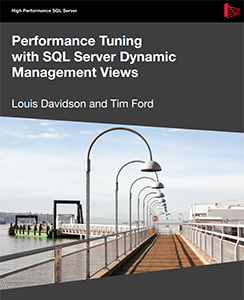
Le DMV (Dynamic Management Views and Functions) sono oggetti che pubblicano informazioni sullo stato di salute dell’istanza SQL Server. Permettono di monitorare il cuore del sistema, diagnosticare problemi e misurare le performance, rappresentano uno strumento utilissimo sia per i DBA che per gli sviluppatori di soluzioni database. Il libro spiega come accedere alle informazioni esposte dalle DMV più frequentemente utilizzate per fare troubleshooting sull’esecuzione delle query, sull’utilizzo degli indici, sulle operazioni di I/O, sulle attività eseguite da una determinata sessione e da una determinata transazione.
Troubleshooting Clusters
Sul canale SQLPASS TV è stata pubblicata la sessione Troubleshooting Clusters tenuta da Allan Hirt (@SQLHA) durante lo scorso PASS Summit 2013.

Abstract
Whether you are new to clusters or have years of experience, you may still cross your fingers when implementing a failover cluster instance (FCI) of SQL Server or an availability group (AG). Both require an underlying Windows Server failover cluster (WSFC), but how many DBAs are involved in the planning and deployment of it? What happens if you try to install an FCI or configure an AG and things don’t work? Or worse, what if the implementation fails after going live in production? This session will cover how to diagnose what went wrong and the free tools available to you, as well as demonstrate how to fix common issues that every DBA should know about.
Skewed Data - Poor Cardinality Estimates... and Plans Gone Bad
Sul canale SQLPASS TV è stata pubblicata la sessione “Skewed Data, Poor Cardinality Estimates, and Plans Gone Bad” tenuta da Kimberly Tripp (@KimberlyLTripp) durante lo scorso PASS Summit 2013.

Abstract
When data distribution is heavily skewed, cardinality estimation (how many rows the query optimizer expects each operator to process) can be wildly incorrect, resulting in poor quality query plans and degraded performance. You’ve probably seen the advice to update all statistics if a query plan looks wrong - but is that the right advice? In many cases, no! These are “sledgehammer” approaches, and while they might solve some problems (usually parameter sniffing problems), they don’t solve the actual problem. In this session, you’ll learn a generalized yet tailored-to-the-table way to solve query plan quality problems for very large tables (VLTs). Topics will include creating, using, and updating filtered statistics; using forced parameterization and templatized plan guides; and understanding stored procedures and how they can leverage filtered statistics.
SQL Server 2012 Reporting Services Blueprints
Recentemente ho avuto l’occasione di leggere il libro SQL Server 2012 Reporting Services Blueprints scritto da Marlon Ribunal e Mickey Stuewe e pubblicato da Packt Publishing.

Prima di tutto, devo ammettere che Reporting Services non è mai stato tra i miei cavalli di battaglia, chi mi conosce sa che sono più ferrato sul linguaggio T-SQL, sullo sviluppo Database, sull’Analisi delle Performance e così via. Quando ho saputo dell’opportunità di leggere questo libro, ho pensato fosse una buona occasione per migliorare le mie competenze sullo sviluppo di report con SQL Server Reporting Services, avevo però bisogno di un libro pratico che andasse subito al sodo.
Building Your T-SQL Tool Kit: Window Function Fundamentals
Sul canale SQLPASS TV è stata pubblicata la sessione Building Your T-SQL Tool Kit: Window Function Fundamentals tenuta da Christina E. Leo (@christinaleo) durante lo scorso PASS Summit 2013.

Abstract
Have you pulled a script to identify duplicates from a blog post but couldn’t quite get it to work because you weren’t sure what that ROW_NUMBER() function was doing? Maybe you heard talk about creating running totals without using subqueries, but you got frustrated when the groups weren’t totaling correctly. Or maybe, you’ve never even heard of window functions. All are good reasons to attend this all-demo session, which demystifies this versatile T-SQL tool. First, we’ll break apart the OVER clause, the key to understanding how window functions work. Then we’ll expand on each group of functions that can use the OVER clause: ranking, aggregate, and analytic functions. Finally, we’ll look at real scenarios where this tool works and talk about performance considerations. When you leave, you’ll have the fundamentals you need to fully develop your mastery of window functions.